

When commercial print shops run a roll-to-roll UV DTF (ultraviolet direct-to-film) printer across dozens of mixed B2B decal orders per shift, overall profitability depends on balancing gang-sheet nesting density against manual scissor-and-trimmer cutting speed: packing vector logos too tightly without straight cut lanes saves a few centimetres of A/B film on the roll, yet adds double that cost back in slow finishing labour and accidentally nicked adhesive borders.
Structuring a disciplined RIP nesting workflow lets production teams maximise usable film area while keeping downstream trimming and order sorting fast and error-free.
Why Over-Packed Freeform Nesting Slows Down Finishing Benches
Auto-nesting algorithms in vector design and RIP software packages often rotate and interlock odd-shaped graphics like jigsaw pieces to squeeze maximum ink coverage into every linear metre of A-film. While jigsaw nesting works well on automated laser or flatbed digital die-cutters, most commercial UV DTF crystal transfers are trimmed into individual application squares by hand using rotary trimmers, guillotine cutters, or shop scissors before being applied to drinkware and gift boxes.
When pre-press staff dump twenty different customer logos into a chaotic, rotated jigsaw layout, three downstream bottlenecks immediately appear at the finishing table:
- No straight rotary-trimmer lanes: Operators cannot slide a long roll section through a straight-line rotary trimmer if emblems from Row B jut into the cutting gutter of Row A, forcing tedious freehand scissor cutting around every decal.
- Adhesive edge contamination from close trims: Cutting within 1 mm of a UV DTF graphic exposes the soft pressure-sensitive adhesive perimeter to paper lint, finger oils, and B-film edge lift before the decal ever reaches the product.
- Mixed-order sorting confusion: Scattering fifty small bottle crests for Client A into the empty corners around Client B’s box labels leads to miscounted shipments and lost pieces during packing.
RIP Gang-Sheet Layout Matrix for Roll-to-Roll UV DTF Production
High-output UV DTF print shops group and space their gang sheets using four structured layout rules rather than relying on blind auto-nesting.
| Layout Parameter | Recommended RIP Nesting Rule | Downstream Finishing Benefit | Common Mistake to Avoid |
|---|---|---|---|
| Horizontal & vertical cut gutters | Maintain straight 8–12 mm orthogonal cut lanes between graphic rows and columns | Allows rapid straight-line cross-cuts and longitudinal slitting on a rotary trimmer | Interlocking rotated shapes that force operators to weave scissors around fragile serifs |
| Order & SKU block grouping | Nest all copies of a single client SKU into a contiguous rectangular block with a small micro-text job ID on the trim margin | Finishing staff can slice one complete customer order off the roll in four straight cuts | Sprinkling small filler logos from one customer inside the gaps of another customer’s urgency order |
| Varnish & pass-count batching | Group standard flush-gloss jobs on one gang run and high-build 3D embossed varnish jobs on a separate run | Prevents a single 3D embossed logo from forcing an entire 3-metre gang sheet to print at slow multi-pass carriage speed | Mixing one heavy embossing file into a 2-metre standard run, cutting hourly printer throughput in half |
| Safe B-film handling tab | Leave a clean 5–8 mm unprinted border around individual decals after trimming | Gives assembly staff a clean corner to lift the A-film backing without touching the tacky graphic adhesive | Trimming flush against the ink edge, which makes peeling the A-film backing slow and damages fine corners |
Batching Roll Runs by Curing Speed and Varnish Thickness
One of the easiest ways to double daily linear-metre output on a commercial roll-to-roll UV DTF line is separating RIP queues by pass count and varnish build. In roll-to-roll printing, the carriage speed and UV LED curing cadence of the entire gang width are governed by the most demanding element on that row.
If a pre-press operator nests ninety standard single-layer varnish bottle decals alongside five high-build 3D tactile crests on the same two-metre gang sheet, the printer must run the entire two-metre web at the slow, high-pass embossing speed. Splitting the queue into a “Standard Gloss Gang Queue” and a “High-Build 3D Relief Queue” allows the standard queue to finish at full production speed while reserving slow multi-pass jetting strictly for premium orders that pay for the extra machine time.
Matching Roll-to-Roll UV DTF Hardware Width to Daily Gang-Sheet Workflow
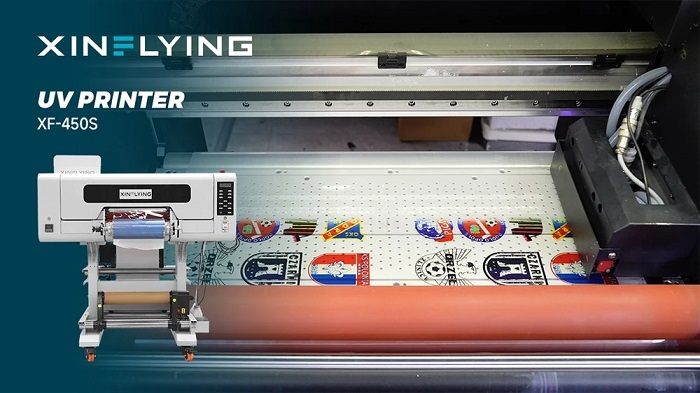
Once a shop standardises orthogonal cut lanes and pass-count batching, selecting the right printer width ensures that nested blocks fill the web from margin to margin without wasted side strips. Print shop owners evaluating mid-format industrial roll-to-roll machines such as the XINFLYING XF-450S—or comparing compact 42 cm units like the XF-420S and wide 60 cm four-head platforms like the XF-600S—can review the complete specifications across XINFLYING UV DTF printer equipment to align roll width and RIP workflow with their daily order density.
By pairing a reliable inline-laminating platform like the XINFLYING XF-450S with straight-lane block nesting and queue separation, commercial print shops cut both film scrap and finishing table labour across every shift.